



Tallow vs. Coconut Oil for Skin: Which Is Better?
Coconut oil has been the darling of natural skincare for years, and for good reason: it is affordable, widely available, and smells like a tropical vacation. Grass-fed tallow is the quieter, older option that is winning people back. If you are deciding between the two, this honest comparison breaks down how each behaves on skin, where each shines, and which is likely to suit your face and body.
Where each one comes from
Coconut oil is pressed from the meat of the coconut. It is a plant fat that is solid at cooler room temperatures and melts easily with warmth. It is inexpensive and easy to find in any grocery store.
Tallow is rendered beef fat. When it comes from 100 percent grass-fed, grass-finished cattle and is hand-rendered in small batches, it is a clean, nutrient-rich fat that people have used on skin for centuries. Both are natural. Their differences show up in the chemistry, and that chemistry is what determines how they treat your skin.
The biggest difference: how they match your skin
Your skin makes its own oil, called sebum, which is a blend of fatty acids like oleic, palmitic, and stearic acid. This matters because the closer an oil is to your own sebum, the more easily your skin recognizes and absorbs it.
Tallow is remarkably close to human sebum. That is why it tends to sink in and feel skin-like rather than greasy. Coconut oil has a very different makeup, dominated by lauric acid and other medium-chain fatty acids that are not a strong match for human skin. Coconut oil can feel light going on, but for many people it sits on the surface rather than absorbing, and it does not replenish the same lipids your barrier is built from.
The pore-clogging question
This is where the two really part ways for facial use. Coconut oil is widely reported to be comedogenic, meaning it is prone to clogging pores, especially on the face and especially for people who are acne-prone. Plenty of people have loved coconut oil on their bodies only to break out when they tried it on their faces.
Tallow, because its profile mirrors sebum and it tends to absorb rather than pool, is generally low-clogging for most people. It is not zero risk (no oil is universal), so patch testing is always wise. But if your main worry is breakouts on your face, tallow is usually the safer bet of the two.
Vitamins and nourishment
Grass-fed tallow naturally carries the fat-soluble vitamins A, D, E, and K, the same nutrients found in many premium skincare products, already in a form your skin knows how to use. Coconut oil contains some vitamin E and has antioxidant and antimicrobial properties, but it does not carry the broad range of skin-repair vitamins that grass-fed tallow does. If you want your moisturizer to feed your skin as well as coat it, tallow has the edge.
Texture, scent, and everyday feel
Coconut oil is famously fragrant, with that sweet, tropical smell, which some people love and others find overpowering (refined coconut oil is more neutral). It melts fast and can feel slick. Tallow, properly rendered, has a mild, nearly neutral scent that fades quickly, with a firmer balm texture that softens on contact with warm skin and presses in cleanly. If you are sensitive to strong scents, tallow is the calmer choice, and a good unscented tallow balm has essentially no lingering smell.
Shelf life and stability
Both are reasonably shelf-stable. Coconut oil resists rancidity well thanks to its saturated fat content and can last a long time. Tallow is also very stable, historically used as a storage fat before refrigeration, and typically keeps 12 to 18 months when stored cool, dry, and closed. Neither requires refrigeration.
Side by side
| Grass-fed tallow | Coconut oil | |
|---|---|---|
| Source | Rendered beef fat (grass-fed) | Pressed coconut meat |
| Matches skin's oil? | Very closely | Not closely |
| Absorption | Sinks in, skin-like | Often sits on top |
| Pore-clogging risk | Low for most | Higher, especially on faces |
| Vitamins | A, D, E, K | Mainly E |
| Scent | Mild to neutral | Strong coconut (unrefined) |
| Best for | Face, dry & sensitive skin | Body, hair, some skin types |
When coconut oil is a fine choice
To be fair to coconut oil, it has real uses. It is a lovely, affordable body moisturizer for people whose skin tolerates it, a popular hair and scalp treatment, and handy for things like removing makeup or softening cuticles. If you love it on your body and it has never caused you trouble, there is no reason to abandon it there.
When tallow is the better pick
Tallow tends to win when it comes to the face and to skin that needs real repair: dry, very dry, sensitive, reactive, or eczema-prone skin. Because it mirrors sebum, carries skin vitamins, and is low-clogging for most people, it is a more dependable facial moisturizer than coconut oil, and it is gentle enough for the whole family. If you have ever broken out from coconut oil on your face, tallow is the natural next thing to try.
Can you use both?
Absolutely. Many people keep coconut oil for hair or body and use a tallow balm for the face and for any dry, sensitive, or problem areas. They are not mutually exclusive. If simplicity is your goal, though, a single quality tallow balm can cover face, body, hands, lips, and dry patches, replacing several products at once.
A closer look at the fatty acids
The reason these two behave so differently comes down to their building blocks, so it is worth a slightly closer look.
Human sebum is dominated by fatty acids like oleic and palmitic acid, along with wax esters and squalene. Grass-fed tallow is rich in the same oleic, palmitic, and stearic acids, which is exactly why your skin treats it almost like its own oil, recognizing and absorbing it. This close match is the single biggest reason tallow tends to sink in and feel skin-like.
Coconut oil is built very differently. It is dominated by lauric acid, a medium-chain fatty acid that is unusual among plant oils. Lauric acid has genuine antimicrobial properties, which is part of coconut oil's appeal, but it is not a strong structural match for human skin lipids. That mismatch is why coconut oil, despite feeling light at first, often ends up sitting on the surface rather than integrating, and why it is more prone to clogging facial pores for many people. Neither oil is "bad." They are simply built for different jobs, and human facial skin is a job tallow is naturally suited to.
Face vs. body: why the answer can differ
One of the most useful distinctions is that the best choice can depend on where you are using it. The skin on your face is thinner, more visible, and more prone to congestion than the skin on much of your body. That is why so many people report loving coconut oil on their arms and legs but breaking out when they tried it on their face.
For the face, tallow is generally the safer, more effective pick: low-clogging for most people, biocompatible, and rich in skin vitamins. For the body, both can work well, and coconut oil's affordability and availability make it a reasonable body moisturizer for skin that tolerates it. If you only want one product to cover both face and body, tallow is the more universally safe choice, since it performs well on the face where coconut oil often struggles.
What about hair?
Coconut oil has one area where it genuinely excels: hair. It is one of the few oils shown to penetrate the hair shaft, which is why it is popular as a deep-conditioning treatment and scalp oil. Tallow is not a traditional hair treatment. So if hair care is your main goal, coconut oil (or a dedicated hair oil) is the better tool. This is a good reminder that "which is better" always depends on the job. For facial and sensitive-skin care, tallow leads; for hair, coconut oil has the edge.
Scent, feel, and the everyday experience
Day to day, the sensory experience matters more than people admit, because you are more likely to stick with a product you enjoy using. Unrefined coconut oil has a strong, sweet, tropical scent that some people adore and others find cloying, especially on the face near the nose. Refined coconut oil is more neutral but has lost some of its natural character. Well-rendered tallow has a mild, nearly neutral scent that fades within moments, and a good unscented tallow balm has essentially no lingering smell at all, which is a real advantage for anyone who is scent-sensitive or simply does not want their moisturizer announcing itself.
Texture-wise, coconut oil melts quickly and can feel slick or even leave a greasy film if overapplied. Tallow balm has a firmer, more substantial texture that softens on contact with warm skin and presses in cleanly, giving a more "finished" feel once absorbed.
Cost and value
Coconut oil wins on sticker price: a jar is cheap and available in any grocery store. But value is not just price. Tallow balm is more concentrated, so you use very little (a pea-sized amount for the face), and a single quality jar can last months while replacing a face moisturizer, body balm, hand cream, and lip treatment. For facial and sensitive-skin use in particular, a small premium for a low-clogging, vitamin-rich balm that actually suits your skin is usually money better spent than a cheap oil that breaks you out. The cheapest product is not a bargain if you cannot use it on your face.
How to decide between them
Here is the simplest way to choose. If your main concern is your face, dry or sensitive skin, or a history of breakouts from oils, go with tallow. If you want an inexpensive body moisturizer or a hair and scalp treatment and your skin tolerates it, coconut oil is a fine choice. And if you want one simple product that does the most jobs safely, including on your face, tallow is the more versatile, more universally suitable option.
Can you use tallow and coconut oil together?
You do not have to choose one and banish the other. Plenty of people find that coconut oil works well as a body oil or a quick moisturizer for arms and legs, while reserving tallow for the face and other areas prone to breakouts. Some balms even blend the two, using a small amount of coconut oil to soften the texture while tallow carries most of the nourishing work. The key is to pay attention to how each behaves on your particular skin and to lead with whichever one your face tolerates best. If coconut oil has caused congestion for you before, keep it below the neck and let tallow handle the more sensitive zones.
Frequently asked questions about tallow versus coconut oil
Which is better for oily or acne-prone skin?
Coconut oil has a higher comedogenic reputation and is a more common culprit for clogged pores on the face, particularly for oily and acne-prone skin. Tallow, whose fatty-acid profile mirrors human sebum, tends to sit better on those skin types for many people. Neither is universal, so patch test, but if your main concern is breakouts, tallow is usually the gentler starting point for facial use.
Which absorbs better?
Coconut oil feels lighter and can seem to absorb quickly, but it can also sit on the surface and feel greasy as it lingers. Tallow feels richer going on yet tends to melt into the skin at body temperature and settle without a slick film. On dry or mature skin especially, tallow often feels more genuinely absorbed once it has had a minute.
Is coconut oil vegan and tallow not?
Correct. Coconut oil is plant-derived and suits vegan routines, while tallow is an animal fat and does not. For anyone choosing products on ethical or dietary grounds, that difference may settle the question on its own, regardless of performance.
Which lasts longer on the shelf?
Both are relatively stable, but tallow is notably shelf-stable and slow to go rancid, and coconut oil also keeps well in a cool, dark spot. Neither requires refrigeration. Store both away from heat and light and they will stay usable for a long time.
Which is better in cold, dry weather?
Tallow's richer, more occlusive nature makes it a strong choice for winter, when skin loses moisture fast and needs a fat that seals as well as nourishes. Coconut oil can help too, but many people reach for the heavier balm when the air turns harsh.
Which is more affordable?
Coconut oil is inexpensive and widely available, which is part of its appeal, while a quality grass-fed tallow balm usually costs more per jar. The gap narrows when you consider how little tallow you need per use and how many jobs one jar does, but if raw upfront cost is the deciding factor, coconut oil wins on price alone.
Which is better for the whole body versus the face?
Many people happily use coconut oil as a body oil while choosing tallow for the face, where its sebum-like profile and lower likelihood of clogging pores are an advantage. If you want one product for everything, tallow tends to be the safer all-over choice for those prone to facial breakouts.
Do dermatologists prefer one over the other?
Neither is a standard dermatological recommendation; both are natural moisturizers rather than clinically studied treatments. Dermatologists generally focus on barrier support and irritation risk, and on that basis they often caution acne-prone patients about coconut oil on the face. As always, individual response and a patch test matter more than any general rule.
Is tallow or coconut oil better for your face?
For most faces, tallow is the safer, more effective choice. It mirrors the skin's own oils, absorbs cleanly, carries skin vitamins, and is low-clogging for most people, while coconut oil is more likely to clog facial pores.
Does coconut oil clog pores more than tallow?
Generally yes. Coconut oil is widely considered comedogenic, especially on the face, whereas tallow tends to be low-clogging because it closely matches human sebum.
Which absorbs better, tallow or coconut oil?
Tallow usually absorbs better into skin because its fatty-acid profile is close to your own sebum. Coconut oil more often sits on the surface.
Can I use coconut oil on my body and tallow on my face?
Yes. Many people do exactly that. Coconut oil works well for body and hair, while tallow is a dependable facial and sensitive-skin moisturizer.
Does tallow smell better than coconut oil?
If you dislike strong coconut scent, yes. Well-rendered tallow has a mild, nearly neutral scent that fades quickly, and an unscented version has essentially no lingering smell.
How White Sparrow makes its tallow balm
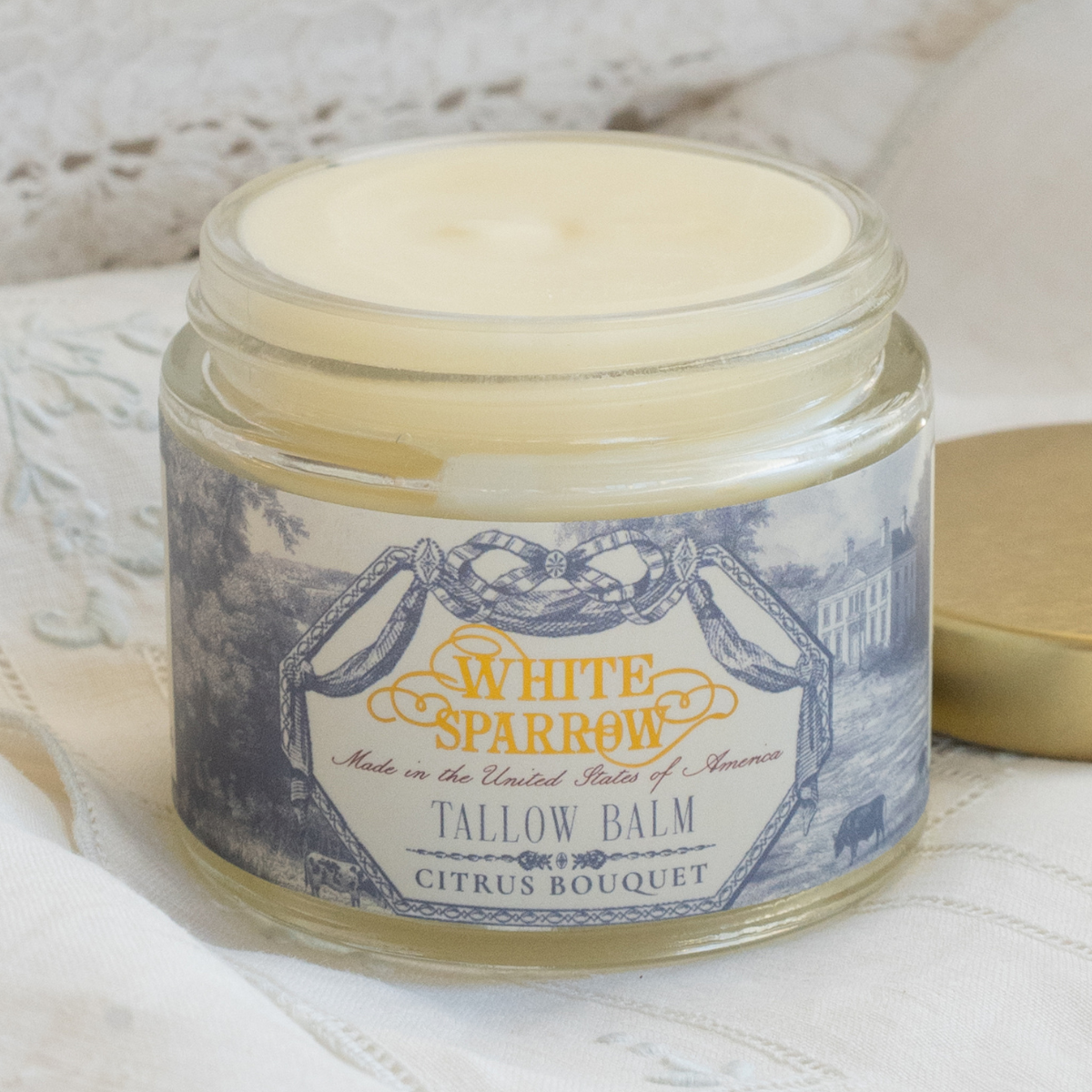
Our tallow balm is made from 100 percent grass-fed, grass-finished tallow, hand-rendered in small batches at our family's 1884 general store in Middleton, Idaho, with a short ingredient list and a fully unscented option for sensitive skin. If coconut oil has let your face down, this is a gentle, low-clogging alternative to try, and it comes with a 30-day money-back guarantee so you can find out risk-free.
→ Shop our grass-fed tallow balm
→ Also see: Tallow vs. Shea Butter
White Sparrow Farmacy hand-renders grass-fed tallow skincare in small batches at a general store built by our pioneer relatives in 1884 in Middleton, Idaho.