



Does Tallow Cause Acne? The Truth About Tallow and Breakouts
It's the first question almost everyone with breakout-prone skin asks before trying tallow: if I put animal fat on my face, won't I break out? It's a fair worry. We've spent years being told that anything rich or oily is the enemy of clear skin. So let's give this question the honest, thorough answer it deserves, no hype, no hand-waving.
The short version: for most people, high-quality tallow does not cause acne, and many people with acne-prone skin find it calming. But "most people" isn't "everyone," and the quality of the tallow and how you use it matter enormously. This guide walks through why tallow behaves the way it does on skin, what actually causes breakouts, who should be cautious, and exactly how to trial tallow if your skin is prone to acne.
First, what actually causes acne?
To understand whether tallow helps or hurts, it helps to know what acne really is. A breakout forms when a pore becomes clogged with a mix of dead skin cells and sebum (your skin's natural oil), bacteria multiply in that trapped environment, and the surrounding tissue becomes inflamed. Four factors drive that process:
- Excess or sticky sebum. When skin produces too much oil, or oil that's thick and sticky, it's more likely to plug a pore.
- Dead skin cells that don't shed properly. If cells clump instead of sloughing off, they combine with oil to form a plug.
- Bacteria (C. acnes). These normally live on skin harmlessly, but thrive in a clogged, oxygen-poor pore.
- Inflammation. The redness, swelling, and soreness that turn a clogged pore into a visible pimple.
Notice what's not on that list: "using an oil." The problem isn't oil itself, your skin makes oil on purpose. The problem is the wrong kind of oil, too much of it, or oil combined with poor shedding and inflammation. This distinction is the whole key to understanding tallow.
Why tallow behaves differently from most oils
Here's the piece that surprises people. Tallow, rendered beef fat, has a fatty-acid profile remarkably close to human sebum. Both are rich in oleic, palmitic, and stearic acids. In other words, tallow is chemically similar to the oil your own skin already makes.
That similarity matters for two reasons. First, skin tends to recognize and absorb tallow rather than letting it pool on the surface. An oil that sinks in is far less likely to sit in a pore and form a plug than one that lingers on top. Second, because tallow is so close to sebum, it can help "trick" skin into feeling adequately moisturized. Skin that feels dry and stripped often responds by producing more oil to compensate, a rebound that can itself trigger breakouts. A moisturizer the skin accepts can, counterintuitively, help oily skin calm down.
This is why so many people who expected tallow to wreck their skin report the opposite: less midday oiliness, fewer clogged pores, and calmer skin overall.
Is tallow comedogenic?
"Comedogenic" means "likely to clog pores." You'll see comedogenic ratings thrown around online, but it's worth understanding how flawed those ratings are before you trust them.
The original comedogenicity scale came from studies done decades ago, often on rabbit ears, using pure, undiluted ingredients in high concentrations. Rabbit ears are far more reactive than human facial skin, and no one uses ingredients the way those tests applied them. So a "rating" you find for an oil may not reflect how it behaves on a real human face inside a finished product.
Tallow doesn't have a clean, universally agreed comedogenic number, partly because it's a whole fat rather than a single isolated oil, and partly because its composition varies with how the animal was raised. What we can say is this: tallow's high similarity to sebum and its tendency to absorb rather than sit on the skin make it behave, for most people, like a low-clogging option. But "low" is not "zero," and skin is individual. That's why patch testing (more on that below) matters more than any chart.
Why the quality of the tallow is everything
If there's one thing to take from this article, it's that "tallow" is not one product. The tallow in a cheap mass-market balm and the tallow in a carefully made small-batch balm can behave very differently on acne-prone skin.
Grass-fed vs. grain-fed
Tallow from cattle raised on pasture their whole lives has a different fatty-acid profile than tallow from grain-finished feedlot cattle, richer in the fat-soluble vitamins (A, D, E, K) and conjugated linoleic acid that support skin health. Higher-quality fat tends to be lighter, cleaner, and better tolerated.
How it's rendered
Rendering is the process of gently melting and purifying the fat. Slow, low-heat, small-batch rendering produces a clean, stable, neutral balm. Rushed, high-heat, or careless rendering can leave impurities and oxidized fat behind, and oxidized, low-quality oils are exactly the kind that irritate and clog. If a balm smells strongly "beefy," that's often a sign of lower-quality rendering.
What else is in the jar
Many breakouts blamed on "tallow" are actually caused by something else in the formula, synthetic fragrance, cheap filler oils, or pore-clogging additives. A balm with a short, clean ingredient list gives your skin far less to react to. If you're acne-prone, look for a fragrance-free option with just a handful of recognizable ingredients.
What about "purging" when you first start?
Some people notice a short-lived increase in small bumps or breakouts in the first week or two of using tallow. This is often confused with tallow "causing" acne, but it's usually one of two things:
- Using too much. Tallow balm is concentrated. A pea-sized amount covers the whole face. Slathering it on can leave excess sitting on the skin. Cut back and the issue often resolves.
- A brief adjustment period. Any change in routine can nudge your skin's cycle, surfacing congestion that was already forming. If bumps appear and clear within one to two weeks, that's typically adjustment, not a reaction.
The rule of thumb: give it a genuine two-week trial with a small amount before you judge. If breakouts appear and steadily worsen beyond two weeks, that's a sign tallow (or that particular product) may not suit your skin.
Who should be cautious with tallow?
Tallow is well tolerated by most people, but a few groups should go slowly:
- People with a diagnosed beef or red-meat allergy. This is rare, but if it applies to you, check with your doctor before applying tallow topically.
- Very oily, highly acne-prone skin. You may still do well with tallow, but start with a tiny amount on a small area and build up slowly.
- Anyone with active, severe, or cystic acne. Tallow is everyday skincare, not a treatment for medical acne. If you're managing significant acne, work with a dermatologist and treat any new product as a supporting player, not a cure.
How to trial tallow if you have acne-prone skin
Here's a simple, low-risk way to find out how your own skin responds, which matters far more than any general claim.
- Patch test first. Apply a small amount to your inner forearm or along your jawline for three to four days. Watch for redness, itching, or new bumps.
- Start at night, small. Once you've patch tested, use a pea-sized amount as your evening moisturizer only. Warm it between your fingers and press it in.
- Cleanse first, always. Never apply tallow to a dirty face, you'd be sealing in the day's oil and grime. Cleanse gently, pat dry, then apply.
- Choose fragrance-free. For reactive or breakout-prone skin, skip scented versions and use unscented.
- Give it two weeks. Judge results at the two-week mark, not day three. Look at the overall trend, not one stray pimple.
- Adjust the amount. If your skin feels greasy after 30 minutes, you're using too much. Less is almost always more with tallow.
Signs tallow is working for your skin
When tallow suits you, people commonly notice:
- Skin that feels comfortably moisturized rather than tight after cleansing
- Less midday oiliness (skin that isn't overcompensating)
- Fewer small clogged bumps over a few weeks
- Calmer, less reactive skin overall, especially if you came from a long, harsh routine
Tallow and your specific skin type
"Acne-prone" is not one thing, and how tallow behaves depends on your particular skin. Here is what tends to happen across the range.
Oily, acne-prone skin
This is the group most nervous about tallow, and understandably so. But oily skin is often oily precisely because it is dehydrated underneath and overproducing sebum to compensate. When a moisturizer the skin actually accepts calms that panic, oil production can settle down. Many oily, breakout-prone people find that a small amount of tallow at night leaves them less shiny by day, not more. The key word is small: a barely-there amount. If you use too much on already-oily skin, it can feel heavy, so start with less than a pea-sized amount and build only if your skin wants it.
Combination skin
Combination skin, oily in the T-zone and drier on the cheeks, usually does well with tallow because it addresses the dry areas without overwhelming the oily ones, as long as you apply lightly and focus the tiniest bit more on the dry zones. You can even skip the oiliest spots entirely if you like.
Dry, acne-prone skin
This combination is common and frustrating, because most acne products are drying, which makes dry-but-breakout-prone skin worse. Tallow is often a relief here: it delivers the moisture the skin is starving for while being low-clogging, helping calm the cycle of dryness, irritation, and breakouts that harsh acne routines can create.
Common mistakes that make tallow look like the culprit
When people say "tallow broke me out," the cause is often one of these fixable mistakes rather than the tallow itself.
- Using far too much. The single most common error. Tallow is concentrated; excess sits on the skin and can contribute to congestion. A pea-sized amount, or less, is right.
- Applying to a dirty face. Sealing the day's oil, sweat, sunscreen, and grime under a layer of balm is a recipe for clogged pores. Always cleanse first.
- Choosing a scented or low-quality product. Synthetic fragrance and cheap filler oils are frequent irritants. A breakout blamed on "tallow" is often really a reaction to the extras. Choose fragrance-free, short-ingredient balms.
- Layering it over pore-clogging products. If the rest of your routine includes heavy, comedogenic products, tallow gets blamed for a problem it did not cause. Simplify the whole routine.
- Judging too soon. A stray pimple on day three is not a verdict. Skin has cycles; give it a fair two-week trial.
What the science actually supports
It is worth being precise about what we can and cannot claim. The strongest, best-supported point is the similarity between tallow's fatty-acid profile and human sebum, which is why skin tends to recognize and absorb it. That biocompatibility is the mechanistic reason tallow is generally well tolerated, including by many with breakout-prone skin.
What is not well supported is any claim that tallow treats or cures acne. There are no large clinical trials showing tallow clears acne, and it should never be positioned as a medical treatment. The honest, evidence-aware position is this: quality tallow is a gentle, biocompatible moisturizer that most acne-prone people tolerate well and some find calming, and it is not a substitute for dermatological care when acne is significant. Anyone who promises tallow will cure your acne is overselling it. We would rather you go in with clear, realistic expectations, because that is how people end up genuinely satisfied.
Building an acne-friendly routine around tallow
Tallow works best as one part of a gentle, simple routine, not a standalone miracle. Here is a sensible framework for breakout-prone skin.
- Cleanse gently, twice a day. Use a mild, non-stripping cleanser. That harsh, squeaky-clean feeling triggers rebound oil, which feeds breakouts.
- Treat, if needed, on clean skin. If you use a dermatologist-recommended acne treatment, apply it to clean skin and let it absorb first.
- Moisturize with a small amount of tallow at night. Warm it, press it in, keep it minimal.
- Protect during the day. Non-comedogenic sun protection matters, because some acne treatments increase sun sensitivity.
- Keep it consistent and simple. Fewer, gentler products give breakout-prone skin the best chance to settle.
The theme throughout is gentleness. Acne-prone skin is frequently over-treated, and a calmer routine built around a biocompatible moisturizer often does more good than an aggressive one.
Frequently asked questions about tallow and acne
Is tallow comedogenic?
Comedogenicity ratings are largely based on older, high-concentration animal studies and do not always predict how an ingredient behaves on real human skin. Grass-fed tallow closely mirrors the fatty-acid profile of our own sebum, which is part of why many acne-prone users tolerate it well. That said, skin is individual. The honest answer is that tallow is low-risk for most people but not guaranteed for everyone, which is exactly why a patch test matters.
Can tallow help with acne scars?
Tallow is not a scar treatment, and no balm can erase scarring. What it can do is keep healing skin supple and comfortable, which supports the skin's own repair process and reduces the tight, dry feeling that sometimes follows a breakout. For raised or pitted scars, a dermatologist can discuss options that actually target scar tissue.
How long before I know if tallow is breaking me out?
Give any new product a fair trial of two to four weeks. Skin often goes through a brief adjustment period, and one or two blemishes in the first days are not necessarily a reaction. A true breakout from a product tends to be clustered where you applied it and persistent. If you see that pattern, stop and reassess.
Should I use tallow if I already use acne medication?
Many people use a gentle moisturizer alongside actives like retinoids or benzoyl peroxide, which are drying. Tallow can play that supporting role, but timing and layering matter, so it is worth checking with whoever prescribed your treatment before adding anything new.
Does tallow clog pores?
For most people, no, tallow's fatty-acid profile is close to the skin's own sebum, so it tends to absorb rather than sit in pores. Everyone's skin is different, so patch test and start with a small amount if you're acne-prone.
Is tallow good or bad for acne?
Many people with acne-prone skin find tallow calming, because it helps skin feel moisturized so it doesn't overproduce oil. It is not a medical acne treatment, though. For active or severe acne, work with a dermatologist.
Why did I break out when I started tallow?
Usually because of too much product or a brief adjustment period. Cut back to a pea-sized amount, cleanse before applying, and give it two weeks. If breakouts keep worsening past that, tallow may not suit your skin.
Is grass-fed tallow better for acne-prone skin?
Generally yes. Grass-fed, small-batch, cleanly rendered tallow with a short ingredient list gives breakout-prone skin far less to react to than cheap, heavily processed, or fragranced products.
Can I use tallow balm during the day if I have oily skin?
Yes, once you know how your skin responds. Use a very small amount and let it absorb before applying sunscreen or makeup. Start with nighttime use first.
How White Sparrow approaches acne-prone skin
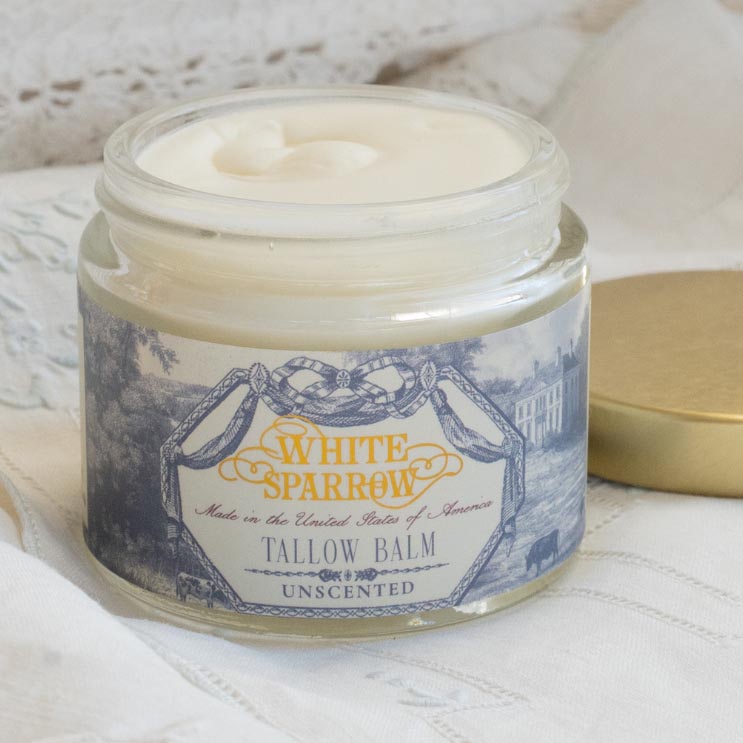
We make our tallow balm the way that gives sensitive and breakout-prone skin the best chance: from 100% grass-fed, grass-finished tallow, rendered by hand in small batches, with a short ingredient list and a fully unscented option. If you're worried about breakouts, the unscented balm is the one to start with, a pea-sized amount at night, after cleansing.
We also back every jar with a 30-day money-back guarantee, precisely because skin is individual. If your skin doesn't love it within a month, send it back. That takes the risk out of finding out how your own skin responds.
→ See our unscented grass-fed tallow balm
→ Related: Is beef tallow safe to put on your skin?
White Sparrow Farmacy hand-renders grass-fed tallow skincare in small batches at a general store built by our pioneer relatives in 1884 in Middleton, Idaho. This article is general education, not medical advice; for persistent or severe acne, please consult a dermatologist.